WineCore Guide · Wine List
Restaurant wine list: how to design it, organize it and sell more
A restaurant wine list should not be just a list of bottles with prices. Well designed, it can become a commercial tool capable of improving the guest experience, making life easier for the floor team and increasing the average spend.
The problem is that many wine lists are built intuitively: references are added because the owner likes them, because a distributor offers them or because it “looks good” to have plenty of variety. However, a list that is too long, badly ordered or hard to understand can produce the opposite effect: the guest freezes, orders “the usual” or simply avoids ordering wine at all.
A good wine list should help the guest choose with confidence. And, at the same time, it should help the restaurant sell better, rotate stock, highlight profitable references and project a more professional image.
In this guide we will look at how to create a restaurant wine list step by step: structure, selection, pricing, pairings, design, common mistakes and how to evolve from a static list to a digital wine list with a QR code.
What you will find in this guide
- What a restaurant wine list is
- Why it affects profitability
- Define the concept before choosing wines
- How to structure the list
- How many wines it should have
- What to include for each wine
- How to set prices
- The importance of wine by the glass
- How to work with pairings
- Design: clarity before decoration
- Common mistakes
- How often to update it
- Printed list, PDF or digital wine list
- How to digitize your wine list
- Downloadable checklist
- Frequently asked questions
Fundamentals
What is a restaurant wine list
The wine list is the document, printed or digital, where the restaurant presents its wine selection to the guest. It can include red, white, rosé, sparkling, fortified and sweet wines, wines by the glass and special references.
But a professional wine list is not limited to displaying products. Its real purpose is to organize the offer, make choosing easier and connect each wine with the restaurant's culinary proposal.
That is why a well-crafted wine list should answer three questions:
Experience
What kind of experience does the restaurant want to offer?
Guest
What does the guest need to understand in order to choose without fear?
Business
Which references should be pushed for margin, turnover or positioning?
When these three questions are aligned, the list stops being a mere catalogue and becomes a silent sales tool.
Business
Why the wine list affects the restaurant's profitability
Wine plays a strategic role in hospitality because it improves the perceived experience and can raise the average spend without a proportional increase in kitchen workload.
A clear wine list can achieve several goals:
- Help the guest choose faster.
- Reduce dependence on the waiter or sommelier.
- Push wines with better margins.
- Move references with slower turnover.
- Reinforce the restaurant's culinary identity.
- Make upselling towards higher-value bottles easier.
A confusing list, on the other hand, creates doubt. If the guest does not understand the regions, varieties, styles or price differences, they will tend to pick the safest option: the familiar wine, the cheapest one, or none at all.
The goal is not to have more wines. The goal is to have a list that is easier to sell.
Starting point
Before choosing wines: define the restaurant's concept
The first mistake when creating a wine list is starting with the bottles. Before choosing references, you should define the restaurant's concept.
A seaside rice restaurant, a fine-dining venue, an urban brasserie, a tapas bar, a steakhouse and an international-cuisine restaurant do not need the same list.
Before selecting wines, answer these questions
- What kind of cuisine do we offer?
- What is our average spend per guest?
- What customer profile do we have?
- Do guests come to celebrate, eat quickly, discover or repeat?
- Can the floor team recommend wines with confidence?
- How much real storage space do we have for bottles?
- Which wines do we want to sell by the glass?
- Which references have the best margin or turnover?
This initial reflection avoids building a disorganized list and lets every wine play a role: entry-level option, safe recommendation, wine by the glass, premium reference, local wine, star pairing or special selection.
Wine list architecture
How to structure a restaurant wine list
Structure is one of the most important factors. A list can hold great wines, but if the guest does not know how to read it, it will not work.
The classic structure — and the most advisable for a general restaurant — is to organize the list by wine type. Within each category, order wines from lower to higher intensity: with reds, for example, start with young, fresh wines, continue with aged wines and finish with reserves or fuller-bodied bottles.
Recommended wine list structure
| Order | Category | What to include | Practical tip |
|---|---|---|---|
| 1 | Wines by the glass | Sparkling, fresh white, fuller white, rosé, young red, aged red, sweet | Few references, easy to keep and rotate |
| 2 | Sparkling | Cava, Champagne, special sparkling wines | Perfect as an opener and for celebrations |
| 3 | Whites | Fresh, aromatic, barrel-aged | Order from lighter to more intense |
| 4 | Rosés | Fresh and gastronomic | They gain weight in summer and on the terrace |
| 5 | Reds | Young, smooth, aged, reserve, signature wines | A progression from light to structured |
| 6 | Sweet & fortified | Sweet wines, Sherry, Port, dessert wines | They boost dessert and after-dinner moments |
| 7 | Special selection | Local wines, organic wines, sommelier's picks, premium bottles | The ideal space to highlight strategic wines |
This structure keeps reading easy and leaves room to highlight strategic wines.
Another way to organize the list: by wine style
Although the type-based structure is the most common, it is not always the most intuitive for guests. Many customers do not know exactly what an appellation, a grape variety or barrel ageing means. They do, however, understand concepts like “fresh”, “fruity”, “smooth”, “intense” or “full-bodied”.
That is why a modern list can combine the classic structure with a reading focused on the wine's profile:
By sensations
- Fresh, light wines
- Aromatic wines
- Smooth, easy-drinking wines
By intensity
- Full-bodied wines
- Barrel-aged wines
By moment
- Wines to share
- Wines ideal for pairing
This approach is especially helpful in restaurants where the guest is not a wine expert. Instead of forcing them to decode technical terms, it guides them towards sensations and moments of consumption.
Sizing the list
How many wines should a restaurant wine list have
There is no perfect number for every restaurant. The ideal amount depends on the type of business, turnover, storage space, average spend and the team's ability to recommend.
| Type of restaurant | Suggested references | Recommended approach |
|---|---|---|
| Tapas bar | 12 – 25 | A short, recognizable selection that is easy to explain |
| Casual restaurant | 25 – 50 | Balance between variety, turnover and margin |
| Fine-dining restaurant | 60 or more | Depth per category and active recommendation |
| Wine bar / specialist | 100+ | Wine is the core of the proposal: breadth with criteria |
What matters is not having a long list, but a balanced one. Every reference should make sense. If some wines are not selling, not being recommended and adding no differentiation, they are probably taking up space and tying up money.
A shorter, well-explained, up-to-date list usually sells better than a huge list nobody understands.
Wine entry
What information to include for each wine
A restaurant wine list should give enough information to guide the guest without overwhelming them. The recommended basics are:
- Wine name
- Winery
- Appellation or region
- Grape variety or varieties
- Vintage, when relevant
- Bottle price
- By-the-glass price, if available
- Short description of the style
- Pairing suggestion
Example of a well-built wine entry
Albariño Rías Baixas
- Grape
- Albariño
- Style
- Fresh white, citrusy and mineral
- Ideal for
- Shellfish, fish and light dishes
This format lets the guest quickly understand what to expect from the wine and which dish to pair it with.
Pricing
How to set prices on a wine list
Pricing strategy is key. It is not just about applying a fixed markup to every bottle, but about building a coherent price ladder. A balanced list should include:
| Tier | Role on the list | Who it serves |
|---|---|---|
| Entry-level wines | A comfortable, friction-free option | Price-sensitive guests |
| Recommended wines | Great value for money, easy to suggest | Most tables |
| Higher-margin wines | References with better profitability or perceived value | Guests open to discovering |
| Premium references | Prestige and cellar depth | Celebrations and expert guests |
| Wines by the glass | Commitment-free tasting and per-dish pairing | Every profile |
The goal is for the guest to find a comfortable option while also having reasons to move up a tier.
Hiding the most interesting wines in the middle of the list. If a reference has a good margin, works with many dishes and guests love it, it should be highly visible: as a house recommendation, sommelier's suggestion or featured wine.
By-the-glass sales
The importance of wine by the glass
Wine by the glass is one of the most powerful tools for selling more wine in a restaurant. It lets the guest try without committing to a whole bottle, makes per-dish pairing easier and opens the door to higher-value references.
A good by-the-glass selection can include
- One sparkling wine.
- Two whites: one fresh and one with more body.
- One gastronomic rosé.
- Two reds: one young and one aged.
- One sweet or fortified wine.
Do not keep too many bottles open at the same time. Wine by the glass should be easy to explain, easy to preserve and easy to rotate.
Gastronomy
How to work with pairings on the wine list
Pairings help the guest decide. There is no need to turn the list into a sommelier masterclass, but simple hints go a long way.
| Type of dish | Recommended wine styles |
|---|---|
| Fish and shellfish | Fresh whites, Albariño, Verdejo, Godello or sparkling wines |
| White meats | Fuller whites, gastronomic rosés or light reds |
| Red meats | Structured reds, crianza or reserva |
| Rice dishes and Mediterranean cuisine | Whites with acidity, rosés or smooth reds |
| Desserts | Sweet wines, fortified wines or semi-dry sparkling |
| Cheeses | Depending on the cheese: aromatic whites, smooth reds or fortified wines |
The list should not impose. It should suggest. Phrases like “ideal for”, “recommended with” or “perfect alongside” help the guest enormously without making them feel insecure.
Presentation
Wine list design: clarity before decoration
Design directly influences the purchase decision. A beautiful list that is hard to read does not sell. For a wine list to work, it should follow these principles:
- Clear categories.
- Legible typography.
- Prices that are easy to find.
- Short descriptions.
- Logical ordering.
- Low visual clutter.
- Highlights for recommendations.
Guests should not need five minutes to understand the list. Too many references, too many columns or too much technical information makes choosing feel heavy. A good list should guide the eye towards the most relevant options.
What to avoid
Common mistakes when creating a wine list
These are some of the most frequent mistakes:
Having too many references without criteria and organizing only by appellation when the guest does not understand the regions.
Not including clear descriptions, not highlighting recommended wines and not offering wines by the glass.
Not updating vintages, prices or stock, and not connecting the wine list with the food menu.
Not training the floor team to recommend with confidence.
Using a static PDF that goes stale and never measuring which wines guests view or choose.
A list can be beautifully designed the day it is printed, but if it is not updated, it soon stops reflecting the restaurant's reality.
Maintenance
How often should you update the wine list
The wine list should be reviewed regularly. As a minimum, review it twice a year, especially if the kitchen changes with the seasons. In restaurants with high turnover or a large list, ideally review it every quarter and make small adjustments whenever needed.
Three key moments to update it
- When the culinary season changes.
- When a reference runs out or changes vintage.
- When sales data shows a wine is not rotating.
The wine list should be a living element. If the restaurant changes, the list should change too.
Format
Printed wine list, static PDF or digital wine list
For years, many restaurants have worked with printed lists or PDFs accessed via a QR code. That may be enough to show a list of wines, but it has limitations.
| Format | Advantages | Limitations |
|---|---|---|
| Printed list | Elegant, tangible, reinforces the venue's image | Requires reprinting every time a price, vintage or reference changes |
| PDF with QR | Easier to update than paper | Still a static list: the same flat catalogue, with no filters or recommendations |
| Interactive digital list | Filters by type, style, price, pairing or grape; featured recommendations; real-time prices; hides out-of-stock wines | Requires a specialized platform and an organized database |
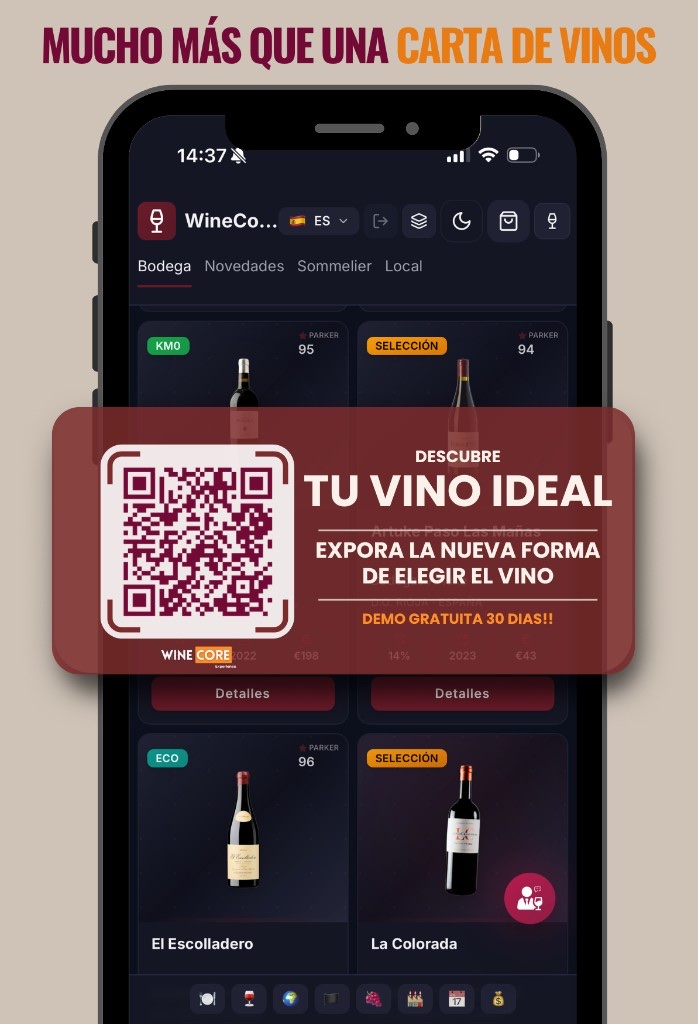
A digital wine list goes one step further. It does not just display wines: it helps guests choose. It can offer filters by wine type, style, price, pairing, grape or appellation. It can also highlight recommendations, hide out-of-stock wines, update prices in real time and present each reference more visually so the guest understands it better.
Static list
Displays information. The guest scans the code and sees the same flat catalogue, with no filters, no recommendations and no truly adapted experience.
Digital list
Guides the decision. Filters, recommendations and a clear presentation that helps the guest choose with confidence and the restaurant sell better.
Step by step
How to digitize a restaurant wine list
Digitizing a wine list does not mean simply uploading a PDF and generating a QR code. That is just moving paper to a screen. To digitize the list properly, follow these steps:
Organize the wine database
Name, winery, region, grape, vintage, price, wine type, stock and pairings.
Define clear categories
So the guest can browse effortlessly.
Write short, understandable descriptions
Avoiding unnecessary jargon.
Add useful filters
Wine type, price, style, pairing or recommendation.
Connect the list to an accessible QR code
From the table, reception or the printed menu.
Review the data regularly
Which wines get viewed the most, which sell and which need more visibility.
When this process is done well, the digital list becomes a sales tool, not just an information display.
The experience
From a static list to the WineCore experience
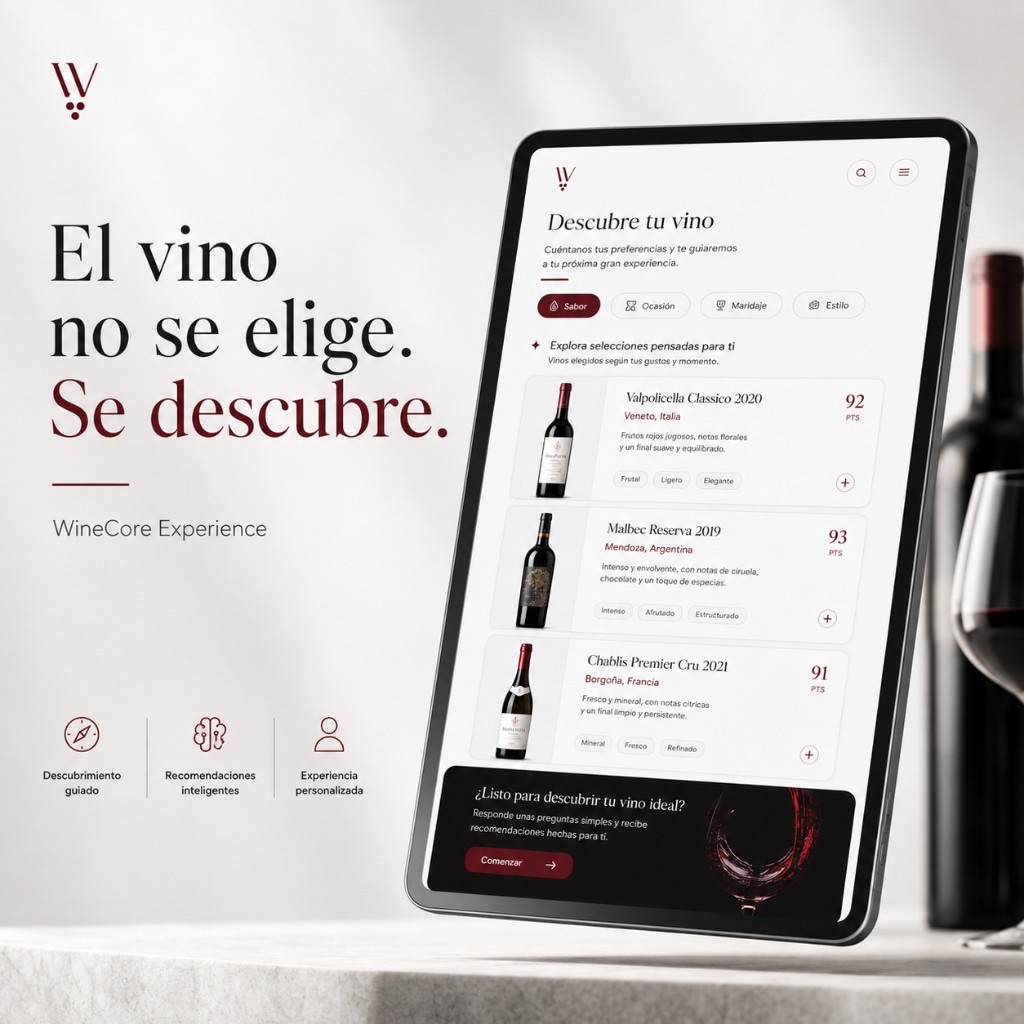
WineCore Experience was designed precisely to solve this problem: transforming the restaurant's wine list into a more visual, intuitive and commercial experience.
Instead of presenting the guest with a cold catalogue of references, WineCore helps guide the choice through recommendations, filters and a clearer presentation of each wine. This makes guests feel more confident when choosing, lets the restaurant highlight strategic references and frees the list from depending solely on the floor team's memory or availability.
A digital wine list does not replace the waiter or the sommelier. It empowers them. It gives them a better tool to sell, recommend and accompany the guest.
Practical actions
How to make your wine list sell more
For a wine list to sell more, it must combine three elements: clarity for the guest, strategy for the restaurant and constant updating.
The best list is not the one that impresses the expert. It is the one that helps the real guest choose better.
Checklist: a wine list that sells
Tick each action as you apply it in your restaurant. You can download it as a PDF.
FAQ
Frequently asked questions about restaurant wine lists
How do you create a wine list for a restaurant?
To create a restaurant wine list, start by defining the concept of the venue, the type of cuisine, the customer profile and the average spend. Then select a balanced range of references by wine type, price, style and pairing. Finally, organize the list clearly and update it on a regular basis.
What should a wine list include?
A wine list should include the wine name, the winery, the appellation or region, the grape variety, the vintage when relevant, the bottle price, the by-the-glass price if available, a short description and a pairing recommendation.
How many wines should a restaurant wine list have?
It depends on the type of restaurant. A tapas bar can work well with 12 to 25 references, while a casual restaurant can manage 25 to 50. Fine-dining or wine-focused restaurants may need larger lists, as long as there is enough turnover and the team can recommend confidently.
Is a long or a short wine list better?
A clear, balanced list is better. A list that is too long can make choosing harder and complicate stock management. A shorter list that is well explained and aligned with the kitchen usually performs better.
How should you organize a wine list?
The most common approach is to organize it by wine type: sparkling, white, rosé, red, sweet and fortified. You can also complement it with style-based categories such as fresh, aromatic, smooth, intense or aged wines.
How often should you update the wine list?
As a minimum, review the list twice a year. In high-turnover restaurants, review it every quarter and update references, vintages, prices and stock whenever necessary.
Is a digital wine list worth it?
Yes, especially if the restaurant wants to update the list easily, improve the guest experience, highlight recommendations and avoid out-of-stock or outdated pricing issues. A well-designed digital wine list does not just display wines: it helps sell them.
Conclusion
A list that organizes, guides and sells
Creating a restaurant wine list is not about piling up references. It is about building a coherent selection that is easy to understand and aligned with the kitchen, the guest and the profitability of the business.
A good list should organize, guide and sell. It should help the guest choose without fear and help the restaurant push the references that truly add value.
And in a context where guests are already used to scanning QR codes, the opportunity is not in digitizing the list as a simple PDF. The opportunity is in turning the wine list into an interactive, visual, recommendation-driven experience.
Turn your list into an experience
With WineCore Experience, your wine list stops being a static catalogue and becomes a living tool to improve the guest experience, make the purchase decision easier and sell every bottle better.
Smart filters, recommendations, pairings and real-time updates: all from a QR code on the table.